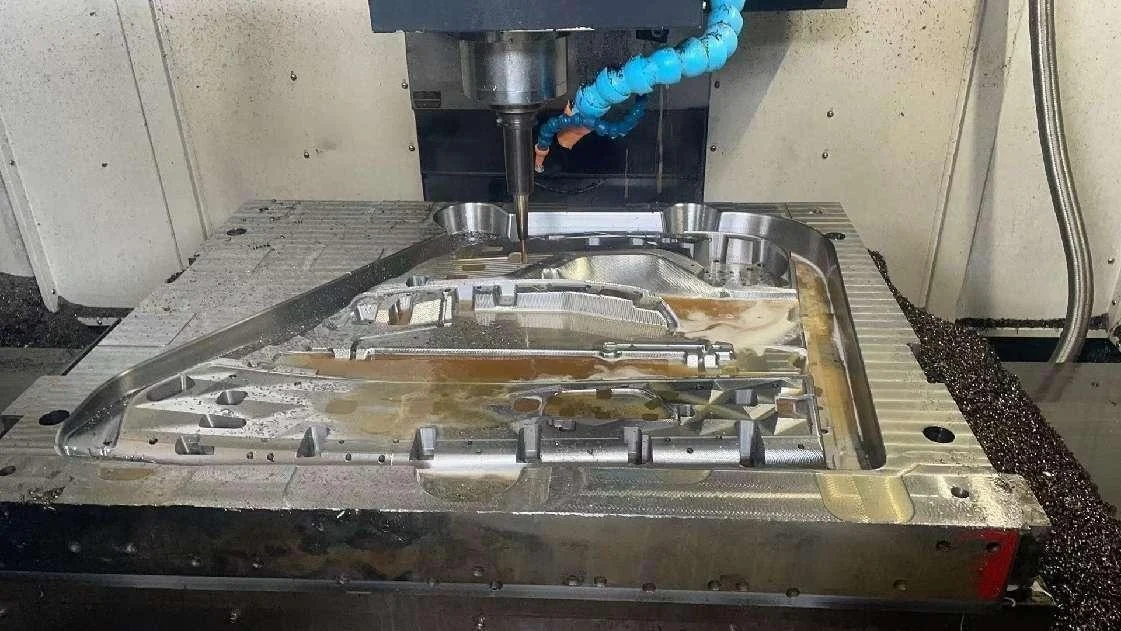
Mirror polish, matte, SPI A2, VDI and a texture code describe different aspects of a surface requirement. Write down the reference system, functional area and acceptance method before the tool is finished.
The four SPI finish families
| Family | Preparation direction | What to agree |
|---|---|---|
| A1–A3 | Diamond polishing | Grade, visual master, waviness and protected edges. |
| B1–B3 | Abrasive paper finishing | Grade and allowed working direction or visible marks. |
| C1–C3 | Stone finishing | Grade and relevant functional or cosmetic surfaces. |
| D1–D3 | Dry abrasive blasting | Reference finish, media and excluded areas. |
DME’s published guide gives approximate resulting Ra values, explicitly in microinches. For example, its A2 reference is 1–2 microinches, about 0.025–0.051 µm. B2 is 4–5 microinches, about 0.102–0.127 µm. These are guide values, not a substitute for an agreed roughness measurement and visual sample.
Why a simple conversion table can mislead
Ra is one numerical description. It does not fully describe texture depth, pattern, lay, waviness, gloss, sharp transitions or how the molded surface looks. A roughness range can overlap across preparation methods while the appearance remains different. Do not approve a texture solely because its average roughness resembles an SPI finish.
Where a customer specifies a VDI reference, a Mold-Tech pattern or another texture supplier’s code, retain that exact reference and the approved plaque. Confirm what the code denotes, how it will be made and where the texture starts and stops. There is no single universal one-to-one conversion covering every SPI, VDI, proprietary texture and Chinese workshop finish name.
Chinese descriptions need the same precision
Terms such as 镜面, 高光, 省模, 哑光, 喷砂, 晒纹 and 皮纹 are useful conversation starters, not complete acceptance specifications. Connect them to a drawing, roughness callout where relevant, appearance master, texture code and inspection conditions. Identify the actual standard and revision when a GB/T or customer standard is specified; do not invent a national SPI equivalence.
A finish specification we can quote
Define the surface: mark cosmetic and functional zones, finish transitions and areas that must remain untreated. Define the reference: grade or texture code, plaque, grain orientation and gloss. Define measurement: parameter, units, direction and measurement conditions, together with the visual inspection arrangement.
Protect the tool: identify shut-offs, vents, fits and thin edges. Review polishing stock removal, texture depth and coating allowance before final sizing. Verify the molded result: use the agreed resin, color and process to approve appearance; changes in those inputs may require a new comparison.
Do not confuse finish with mold life
SPI A2 describes a surface preparation reference. SPI Class 101 describes a tooling construction and production-duty category. Neither statement by itself specifies the tolerance of the molded product. Include all three requirements separately when they matter to the purchase.
Mold finishing services · Mold classes and life · Discuss a surface requirement ↗
References: DME Micro-Finish Mold & Tool Finish Guide; Daido guidance on mold steel polishing and texturing. Values are explanatory references; this article is not a certified surface comparison plate.