A useful engineering review ends with decisions. Before cutting mold steel, agree what the team must decide: release the part geometry, select a molding route, compare gate positions, reduce a specific risk, or prepare a controlled first trial. A report that does not identify an action, an owner and the affected drawing revision leaves the project unfinished.
ESI, DFM and simulation have different roles
Early supplier involvement brings manufacturing questions into product development while changes are still possible. DFM reviews whether the proposed part and tool can be made and handled as intended. Molding simulation evaluates selected process behavior using a model, material data and boundary conditions. They work together, but one does not replace the others.
NewwaySmart’s engineering-to-production route connects material review, tool design, component machining, assembly, trials and production. A customer can start with a specific mold component or request a broader review; the deliverables should remain explicit in either case.
Prepare a controlled input set
Provide the current 3D model and 2D drawing, material grade and filler content, cosmetic surfaces, assembly interfaces, critical dimensions, quantity forecast and target press information where known. Identify unresolved choices. A resin described only as ‘PC’ or ‘PA’ may be insufficient for a grade-specific simulation or a meaningful production commitment.
Autodesk explains that accurate material properties and appropriate data fitting are important to simulation accuracy. Different grades within one family can behave differently. A standard material datasheet is not automatically a complete simulation dataset. Material testing and data fitting reference.
Ask a specific simulation question
Examples include: Can a proposed gate location fill the critical feature? How do two gate arrangements compare? Which region is likely to be last to fill? How does a cooling concept affect the temperature distribution? What trend in distortion should be investigated before releasing an assembly interface?
Define the relevant analysis scope rather than ordering ‘Moldflow’ as a single undifferentiated product. Autodesk describes Moldflow as a plastic-processing simulation tool; the selected analysis, model and inputs determine which questions the work can address. Moldflow product reference.
Record assumptions where data is missing
If the exact resin is unavailable in the database, ask the material supplier about tested data or an appropriate substitute. Autodesk’s guidance for selecting an equivalent material includes the family, filler, viscosity and thermal and mechanical properties. A similar name alone is not a sufficient basis. Equivalent-material selection guidance.
Keep the substitute and its limitations visible in the report. Also record the model revision, gate and runner assumptions, process settings, cooling assumptions and any omitted component. This makes later discussion about a trial result more useful than comparing two screenshots with unknown settings.
Separate directional guidance from guaranteed dimensions
A simulation may be helpful for comparing alternatives without being a guaranteed prediction of every final dimension. Autodesk notes that its uncorrected residual-stress model can predict shrinkage trends while absolute values may be less accurate when measured shrinkage data is unavailable. The specific model and material data matter. Shrinkage-model limitations.
Accordingly, connect predicted concerns to a physical verification plan. For a sealing interface, define the mating parts and functional test. For a flatness concern, define the support condition, measurement method and sample conditioning. For appearance, specify the approved comparison conditions.
Use an action register to close the review
For each finding, record the affected feature, risk, proposed action, responsible party and decision date. Possible outcomes include a drawing change, a tool-design change, a material-data request, an additional analysis or a targeted trial. ‘Reviewed’ should not mean that unresolved issues have disappeared.
A practical release package includes the approved design revision, accepted deviations, key process assumptions, inspection requirements and the planned trial sequence. Changes after release should return to the same controlled record.
Questions customers often ask
Does every small trial mold need a full simulation study? Not necessarily. Scope the engineering effort around the decision and risk. A simple project may need a focused DFM review; a difficult multi-material or distortion-sensitive part may justify more analysis.
Can simulation replace a trial? No. Use it to improve the plan, then verify the real material, tool and process against the agreed acceptance criteria.
Start with ESI-to-production engineering, DFM and trial validation, or send the decision you need the review to support.
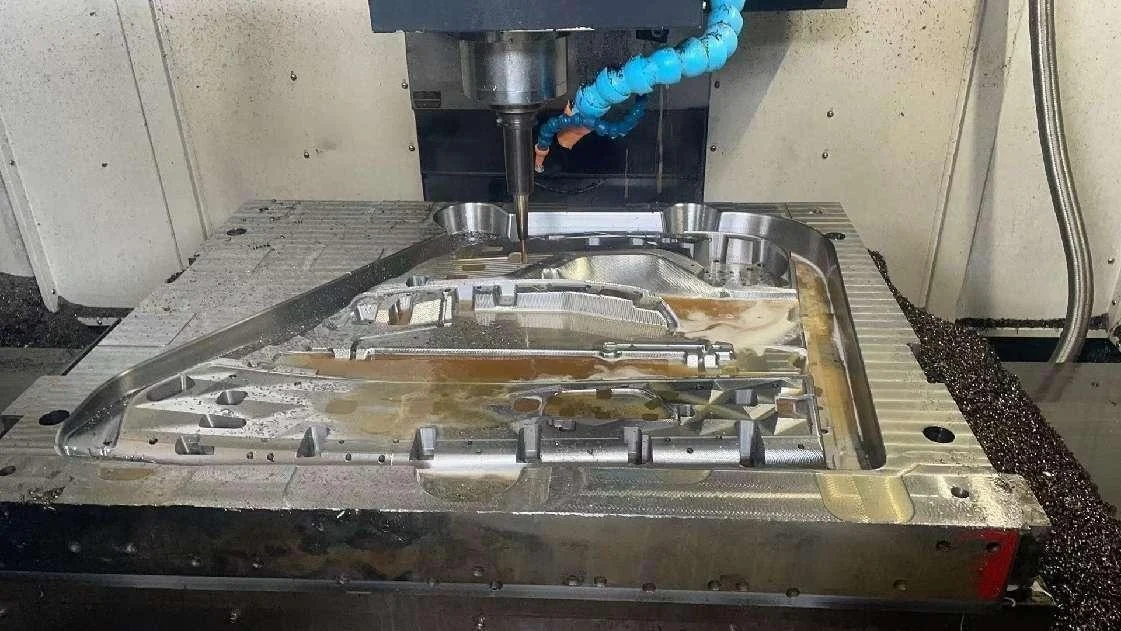
Cover: manufacturing illustration. The purchasing checklist is a recommended project framework, not a substitute for the selected software documentation or an approved engineering report.