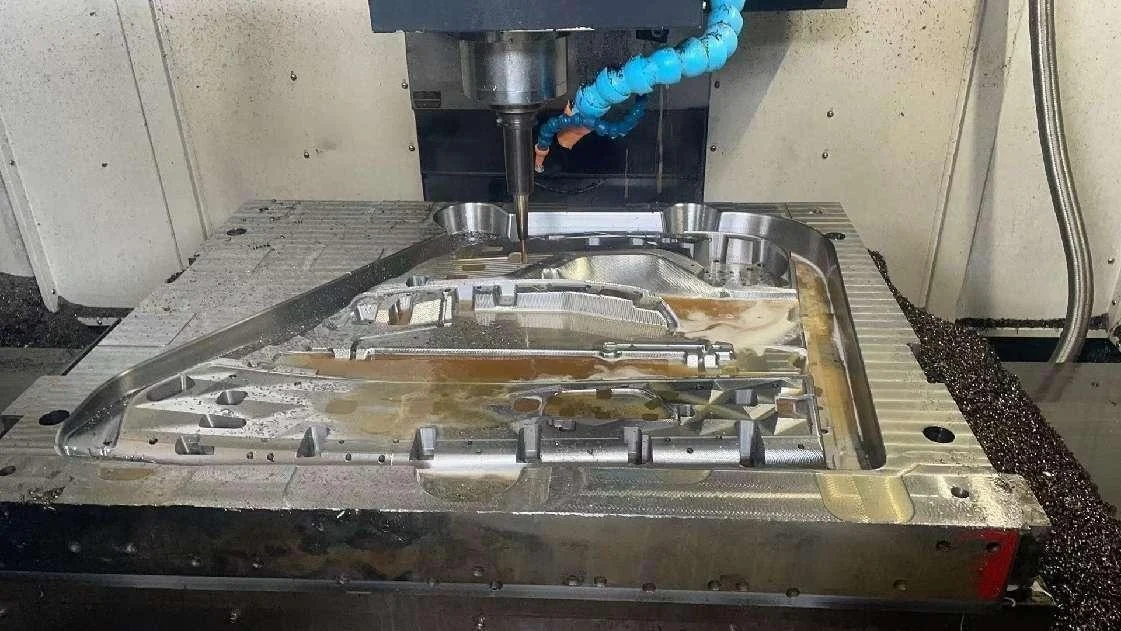
The best route is often a combination. A mold insert may need CNC milling for accessible contours, EDM for difficult cavity details, and grinding for selected reference or fitting surfaces. The purchasing decision should start with the finished component: what must fit, what forms the plastic, which surfaces are critical, and in what condition the part will be inspected.
This guide focuses on mold cores, cavities, inserts, sliders and related tooling components—not general aluminum product machining.
Start with the feature, not the machine list
Mark the drawing with three groups of surfaces: molding geometry, assembly interfaces, and noncritical clearance. Then identify the material grade, supplied condition, final hardness, coating requirements and drawing revision. A tolerance without an identified surface or datum does not define a machining route.
For a deep slot, ask whether a cutter and holder can reach the full depth without interference. For an insert fitted into an existing tool, identify which face locates the part and which surfaces may retain fitting allowance. For a polished cavity, distinguish dimensional limits from appearance requirements.
Where CNC milling belongs
Milling removes material with a rotating cutting tool. It is a practical starting point for many accessible pockets, contours and mold surfaces. Hard milling can also form part of the route for hardened steel; it is not correct to assume that every hardened insert must be finished entirely by EDM. Makino describes hard-milling equipment designed specifically for complex die-and-mold geometry, while emphasizing rigidity and thermal stability. Manufacturer reference: hard milling.
For procurement, however, a machine specification is not an acceptance report for your insert. Ask the supplier to review minimum internal radii, cutter reach, thin features, tool access and how the part will be located after each setup. An internal corner cannot simply be called perfectly sharp without defining a measurable radius or relief.
Where sinker EDM adds value
Sinker EDM uses a shaped electrode and controlled electrical discharges to remove material from an electrically conductive workpiece. The electrode, spark gap and machining conditions form part of the dimensional plan. This makes EDM a route to consider when cavity geometry is difficult to reach with a rotating cutter. It does not mean that electrode dimensions can be copied directly to the finished cavity.
Makino also explains that EDM creates thermally affected surface layers. The required finishing and surface-integrity checks should therefore be defined for the application rather than assuming that an attractive surface proves the entire process is complete. Manufacturer reference: EDM process and surface integrity.
Where grinding fits into the sequence
Consider grinding for specified flat reference faces, shoulders, bores or other suitable features when the geometry and required condition justify it. The important purchasing question is which features are ground, when they are ground, and how they are related to the molding geometry. Do not specify every surface as ground merely because one location needs a tight fit.
A proposed sequence might be rough machining, the agreed heat-treatment route, reference-face finishing, final contour machining or EDM, local surface finishing and inspection. This is an example of process planning, not a universal sequence. Prehardened material or a component supplied with machining allowance may require a different plan.
Three interfaces that deserve explicit agreement
Between processes: define the reference surfaces and how the workpiece is re-established after heat treatment or transfer to another machine. Between finishing operations: state whether dimensions apply before or after polishing, coating or other treatment. Between supplier and toolmaker: clarify who completes fitting, spotting and the assembled mold trial.
For example, a replacement insert can be dimensionally correct to its own drawing but still need fitting when the parent pocket has changed. Resolve the parent-tool condition before treating the machining tolerance as the only requirement.
What to send for a useful quotation
Supply the current 3D model, controlled 2D drawing, quantity per revision, steel designation, final hardness or material condition, critical interfaces, surface requirements and delivery milestone. Include the parent-tool drawing or reliable measurements for replacement work. Identify whether you need a blank, a semi-finished component, a finished insert or an installed-and-trialed result.
Frequently asked questions
Is five-axis machining automatically better? Not for every component. Judge whether the proposed setup improves access, consistency or the number of transfers for your geometry.
Can EDM replace every other operation? A component still needs suitable references, inspection and the other manufacturing operations required by its drawing. Choose the route around the complete part.
NewwaySmart connects precision component machining with mold manufacture and trials. See cores, cavities and inserts, or send drawings for a process-route review.
The cover is a manufacturing illustration, not an inspection record or a promise of machine-specific performance. Final tolerances and delivery conditions are agreed for each drawing.