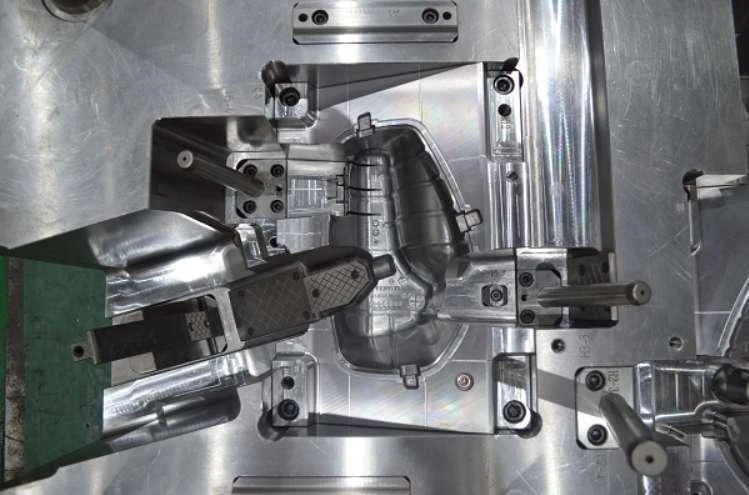
There is no single best steel for every mold. A trial insert for a limited sampling program, a polished cavity for a transparent component and a heavily loaded production detail may justify different materials. A good specification connects the steel to the resin, geometry, finish, service conditions and maintenance plan.
P20, H13 and 420-type stainless mold steels describe useful starting families. They are not permission to treat every supplier product within a family as identical.
First define what the tool must resist
Write down the resin grade, reinforcement or fillers, expected production program, required appearance, process temperature range, cooling conditions and maintenance access. Identify the likely concern: wear, corrosion, local deformation, cracking, polishing quality, or the cost and timing of changes.
This is also the point to distinguish the main cavity from inserts, sliders, wear plates and other components. Selecting a premium cavity steel does not automatically define the correct material for every moving or supporting part.
Prehardened P20-family steels: consider the manufacturing route
Prehardened steels are worth evaluating when their property balance matches the application and avoiding a separate bulk-hardening step has value. Uddeholm describes Impax Supreme, with a W.nr 1.2738/AISI P20 reference, as a prehardened mold steel with machining, polishing and photo-etching characteristics; its specified delivery range is 290–330 HB. Use the exact product data and certificate when selecting it. Producer data: Impax Supreme.
For the buyer, the useful question is not whether P20 is ‘cheap.’ Ask whether the proposed material and delivery condition support the required finish, maintenance interval and planned modifications. A prehardened route can be a sensible engineering choice rather than a compromise made only on price.
H13-family steels: define the required hardened condition
H13 is associated with hot-work tooling. Uddeholm’s Orvar Supreme information also describes plastic-mold applications and resistance to thermal shock and thermal fatigue. This provides a reason to evaluate the grade for suitable duty; it does not mean every plastic cavity needs H13. Producer data: Orvar Supreme.
When this route is proposed, clarify the treatment procedure, final hardness, machining allowance and final inspection. Compare the complete component cost, including the operations after heat treatment, rather than comparing raw steel prices alone.
Stainless mold steels: look at corrosion and surface requirements
Uddeholm identifies Stavax ESR, with W.nr 1.2083/AISI 420 references, for small and medium cores and inserts where corrosion resistance and polishability matter. Its guidance connects the material to surface preservation and cooling-channel corrosion control. Producer data: Stavax ESR.
Do not translate this into a claim that every 420-type or locally named stainless steel has the same cleanliness, heat-treatment response or polishing performance. ‘S136,’ a producer trademark, a national designation and an unspecified stainless plate should not be silently substituted for one another. Confirm the exact source, specification and accepted alternatives.
Not every corrosion-resistant route requires the same treatment
There are also prehardened stainless tooling options. For example, Uddeholm lists Mirrax 40 as an ESR stainless tool steel supplied at 40 HRC. Its existence illustrates why the decision should include both grade and delivery condition, not simply ‘stainless versus P20.’ Producer data: Mirrax 40.
These examples are material references, not a declaration that NewwaySmart uses these particular brands in every order. Approved brands, alternatives and certification requirements are agreed for the project.
What belongs in a mold-steel specification
Record the drawing and revision, exact grade, producer requirements where applicable, supplied condition, final hardness, relevant heat treatment, material traceability, surface target and permitted substitutions. Define critical cavity requirements separately from ordinary support plates. Include any coating, texture or polishing process that the steel must accommodate.
For quotation comparisons, ask suppliers to explain a proposed alternative against these same requirements. A different grade might be appropriate, but the reason should be documented before manufacture rather than discovered during acceptance.
Frequently asked questions
Does a higher hardness always mean a longer mold life? Hardness alone does not describe the whole failure risk or operating condition. Review the full grade properties and the actual wear or damage mechanism.
Can a small trial mold use the same steel as a production mold? It can when justified, but the required sample count, finish, iteration plan and later reuse should drive the decision. Do not automatically overbuild or under-specify it.
See material selection, mold class and life, and why mold prices vary. For a practical comparison, send the part, resin, expected quantities and acceptance requirements.
Cover: manufacturing illustration. Steel equivalence, treatment and suitability require project-specific verification.