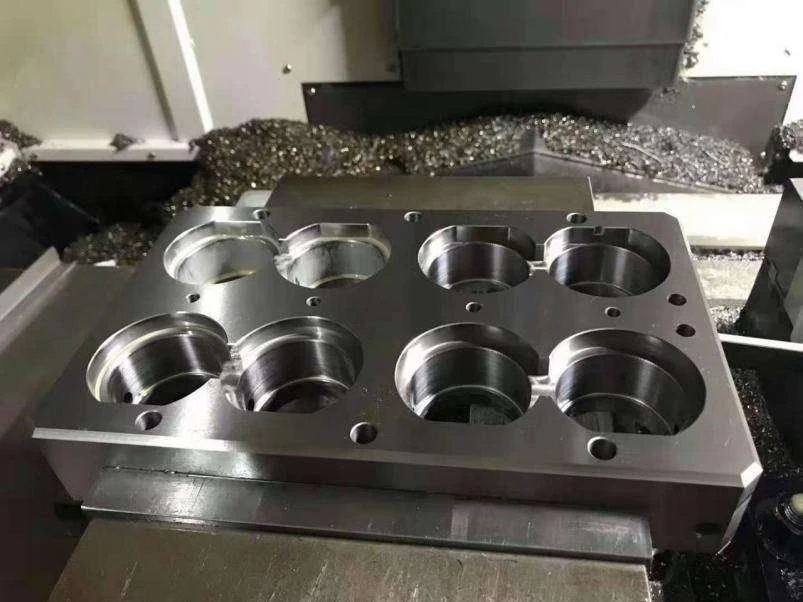
A side action releases geometry that cannot leave the mold along its main opening direction. The right slide is not the most complicated mechanism. It is the simplest arrangement that clears the undercut, supports the molding load and returns reliably within the available space and production plan.
Start with the feature, not the slide catalog
Identify the exact undercut surface, release direction and required clearance. Review the molded material, shrinkage around the feature, surface texture and cosmetic restrictions. Confirm whether the feature can be redesigned, split at a different parting line or formed with a replaceable insert before adding motion.
The required withdrawal includes enough clearance for the entire ejection path, not just the nominal undercut depth. A slide can clear a hook locally yet still obstruct the part, robot gripper or neighboring slide later in the cycle. Check the full motion sequence in the assembled mold model.
Common design routes
| Route | When to evaluate it | Main engineering questions |
|---|---|---|
| Angle-pin or cam-driven slide | Withdrawal that can be linked to mold opening | Available opening travel, engagement, guide length, locking and reliable retention |
| Compact mechanical slide unit | Local undercuts with limited installation space | Catalog stroke and load limits, machinable forming area and replacement access |
| Hydraulic core pull | Motion requiring independent timing or a stroke not convenient for an angle pin | Power supply, position feedback, load support, leak management and sequence interlocks |
| Electric or servo-driven mechanism | A project requiring controlled or coordinated motion | Controls integration, force, duty, thermal environment and maintenance support |
| Hand-loaded insert | Selected prototype or low-volume projects | Safe operating procedure, repeatable location, part removal, labor and missing-insert prevention |
Commercial examples include Meusburger compact slide families and DME slide systems. Their existence offers design options; it does not mean that a catalog unit can be fitted to any undercut without checking its installation and operating limits.
Separate movement, guidance and load support
The device that moves a slide is not automatically the element that should resist the cavity pressure. Define the load path through the slide body, backing or locking surfaces, guides and mold structure. Where a hydraulic cylinder is used, establish whether the particular system is intended to hold the load or whether a separate mechanical lock is needed.
Guide and wear surfaces need a deliberate material and lubrication plan. Review sliding fit in the operating temperature range, edge loading, replaceable wear plates and contamination control. A surface that moves freely on the bench may behave differently after heat-up or when exposed to resin residue.
Sequence failures are often more expensive than machining errors
Specify when the core may retract, when ejection may begin and what must be confirmed before closing. Check possible collisions with ejectors, lifters and the opposing half. Retainers, stops and position confirmation must be suitable for the actual mechanism; they are not interchangeable functions.
During trials, verify movement first under an appropriate controlled procedure, then evaluate it with the selected resin and agreed production conditions. Record witness marks, flash at the slide interface, part damage and any abnormal noise or drag. Mechanical validation and machine safety requirements must both be addressed by competent personnel before routine production.
What can be purchased separately?
NewwaySmart supports drawing-based slide bodies and side-action components, replaceable forming inserts and gibs and wear plates, as well as integration in a complete mold. For replacements, provide the parent-tool interfaces and intended original geometry, not only a worn component.
For a new mechanism, send the part model, undercut section, mold layout, material, expected quantity, target cycle and the receiving press’s available core-pull interfaces. We use that information to compare feasible routes and identify what must be validated. Request a side-action review.
Manufacturer examples
Meusburger E 3072 compact slides; DME EZ-Slider. Selection and integration guidance is not a ready-to-manufacture design or a universal load rating.