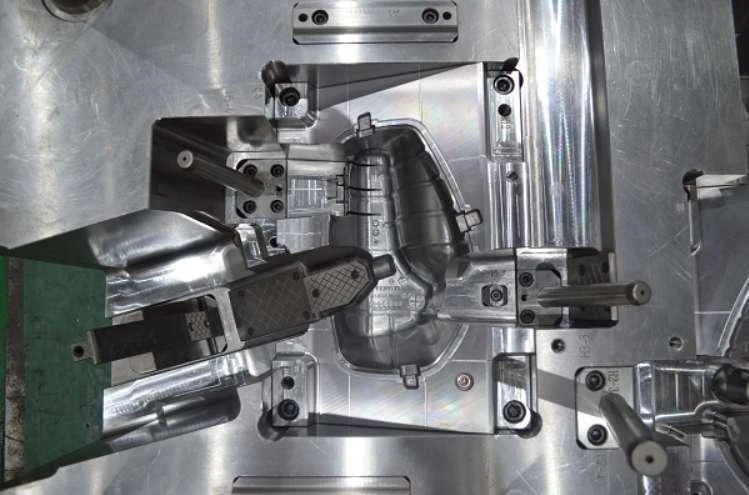
A mold is tooling that gives material a defined shape during a manufacturing process. In plastic injection molding, that includes the forming surfaces and the supporting systems needed to fill, control temperature, open and release the part. Precision mold components are the foundation, but a working mold is an integrated assembly.
Core and cavity: useful names, not a universal front/back rule
The core commonly forms internal features, while the cavity commonly forms the opposing or exterior surfaces. Actual assignments depend on the tool layout. Do not assume that a component called front core, A-side or fixed half has exactly the same meaning in every supplier’s drawing system.
For purchasing, identify the part by its drawing number, revision, assembly position and functional surfaces. A component name helps communication; the controlled drawing defines what must be manufactured. Our Chinese–English mold-component glossary addresses common differences in shop-floor terminology.
What is inside an injection mold?
| Function | Typical elements | What the buyer should clarify |
|---|---|---|
| Form the part | Cores, cavities, inserts and forming pins | Critical geometry, steel, finish, tolerance and acceptance |
| Support and locate | Mold base, support plates, guidance and alignment features | Assembly interfaces, stiffness and receiving-press compatibility |
| Deliver material | Sprue, runners, gates or an agreed hot-runner system | Resin, filling behavior, gate location and purchased-system scope |
| Control temperature | Cooling or heating passages and associated connections | Process requirements, circuit layout, media and testing |
| Release the part | Ejectors, slides, lifters or other release mechanisms | Motion sequence, part condition and reliable return |
| Maintain the tool | Replaceable wear parts, identification and documentation | Service access, spares and the handover package |
A mold, a die and a fixture are not always the same purchase
Usage varies by process and region. Mold and mould are spelling variants. Die is frequently used for extrusion, stamping and other forming tools, while a fixture generally locates or holds a workpiece for another operation. These words should be interpreted with the process and drawing rather than translated as interchangeable catalog categories.
An injection mold makes discrete parts through repeated cycles. An extrusion die shapes material as it flows through an opening, with the downstream line also affecting the final output. A hot-press tool supports a different combination of material placement, pressure and thermal processing. We discuss those distinctions in our material-led tooling article.
Why machining accuracy is important but not sufficient
Accurately manufactured parts help establish the intended geometry and fit. The final molded product also depends on the material, tool design, assembly, process and inspection conditions. A machine specification or an individual insert tolerance cannot be substituted directly for the tolerance of every finished plastic part.
That is why an engineering review starts before steel is cut and continues through fitting and trials. Identify the functional datums, cosmetic areas, assembly interfaces and test method. When a result is not acceptable, the team needs enough recorded information to distinguish a tooling problem from a material or process issue.
What can you order from NewwaySmart?
You can begin with an individual core, cavity, insert or other drawing-based mold component. You can also request a complete tool, a rapid sample route, molding production or downstream assembly and packaging. These are separate scopes that can be combined around the project.
Complete mold work is not limited to micro molding. Our scope includes conventional plastic molds, two-shot and three-shot structures, insert molding and silicone-related tooling, subject to the application review. The starting requirement may be precision machining, while the next stage involves design, fitting, trials and production readiness.
Send the part or component drawing, material, quantity, critical requirements and current project stage. For a complete mold, include the production plan and receiving-machine requirements. A clear RFQ helps define an appropriate tool rather than merely an impressive-looking assembly.
Further reading
DME component families; American Injection Molding Institute: the connected disciplines of materials, part design, mold design and processing. NewwaySmart service scope is described in our engineering-to-production overview.