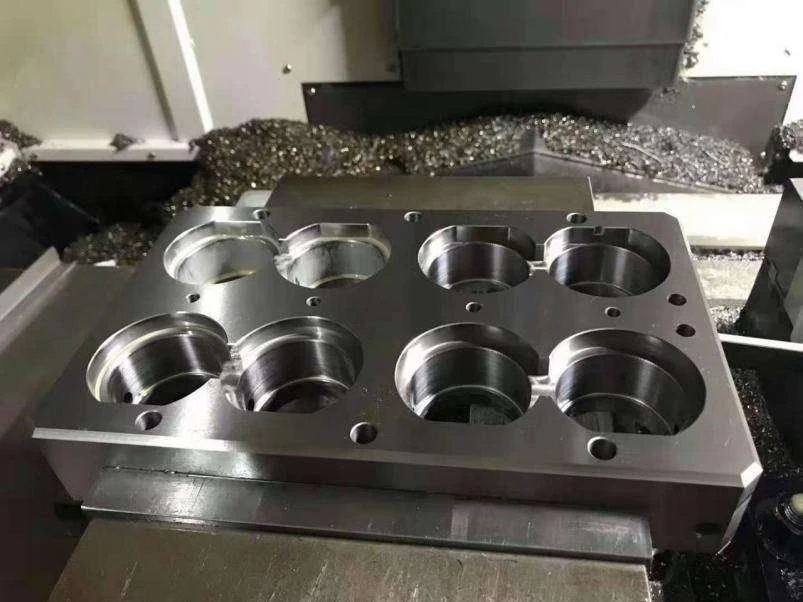
The same insert drawing can lead to very different quotations. One supplier may price a machined blank, another may include hardening and final grinding, and a third may include fitting into the parent mold. Before comparing prices, write down the condition in which you expect to receive the component.
The categories below are suggested purchasing descriptions. They are not universal industry grades. Use the actual drawing and scope to define the deliverable.
1. Material blank or prepared stock
This scope concerns the specified material and starting geometry. State the exact grade, section size, supplied condition, traceability requirements and any prepared reference faces. Distinguish the stock dimensions from the finished insert dimensions. Do not assume that a blank includes cavity machining, a final hardness condition or a ready-to-assemble fit.
A prepared blank can be useful when the customer’s own toolroom will perform the critical machining. The quotation should make that division of responsibility visible.
2. Rough-machined or semi-finished insert
Define which features have been machined, which remain open, and where material allowance is left. Identify the reference faces and how the part will be held for the next operation. Specify whether heat treatment has already occurred or is still part of the customer’s process.
An allowance should have a location and direction, not only a general note. A cavity left undersize for further machining and an external fitting surface left oversize have different meanings. Mark them on the controlled drawing or a clearly referenced process-stage drawing.
3. Heat-treated component awaiting final finishing
For this scope, agree the material condition and evidence of the completed treatment. Confirm the final hardness requirement where applicable, the remaining dimensional stock and any limits relevant to the next manufacturing stage. The receiving toolroom should know which surfaces are process references and which will become final datums.
Do not label this condition ‘finished’ when later grinding, EDM, polishing or fitting remains necessary. The related heat-treatment guide explains why material condition and final inspection must be linked.
4. Finished to drawing
This description should mean that the agreed drawing features are supplied in their specified final condition. List the required dimensions, geometric controls, surface finishes and any coating or texture. State which checks appear in the inspection report and identify the drawing revision on the report and packaging.
‘Finished to drawing’ does not automatically include assembly into a tool the supplier has never received or inspected. Parent-tool condition and the responsibility for final fitting must still be addressed.
5. Matched, fitted or trial-validated supply
Where the order includes fitting, define what will be fitted to what. The work may need the parent mold, mating components, reliable reference data or an agreed assembly fixture. Confirm who performs spotting, adjustment, assembly checks and any molding trial.
NewwaySmart’s documented moldmaking route distinguishes component machining and assembly, first trial, sample and inspection review, further correction, and release for production or shipment. Buying one stage does not silently purchase all subsequent stages.
Specify what the dimensional report must prove
Identify the features that control assembly or product function, their datums, the required measurement condition and the report format. For a set of inserts, state whether the relationship within the set must also be checked. A report should address the agreed acceptance features rather than simply contain many measurements.
For replacement work, distinguish nominal design geometry from measurements of a worn part. Where the original drawing is unavailable, agree how the replacement geometry will be reconstructed and approved. Do not assume that copying wear will restore the intended fit.
Package components for identification and protection
Our recommended delivery checklist identifies the part number, drawing revision, quantity, material condition and any remaining work. Keep matching parts traceable as a set. Specify protection for fine edges, polished faces and contact surfaces, and agree whether a protective coating must be removed before use.
Include the requested material and treatment records, inspection results and any approved deviations. For an exported component, distinguish dispatch date from the required arrival date and identify the delivery destination during quotation.
An example of clearer RFQ wording
Illustrative request: ‘Please quote six cavity inserts to the attached drawing revision. Supply in the specified final material condition, with the listed surfaces finished to drawing and only the marked fitting faces left with allowance. Include the defined dimensional report and identify each insert. Final fitting and mold trials will be performed at our factory.’
This request is still incomplete until the drawing supplies the actual grade, hardness, allowance and acceptance limits, but it makes the commercial boundary much clearer than ‘six inserts, best price.’
Questions to resolve before ordering
Does a very tight machining tolerance guarantee a drop-in replacement? Not when the mating geometry, thermal condition or wear of the parent tool is unknown. Review those conditions as part of the replacement plan.
Can we start with component machining and add mold work later? Yes, the scope can be staged. Agree the interface between stages so that later fitting, trials and production are planned rather than assumed.
Explore precision mold components, replacement inserts and inspection and acceptance. Send your drawing and required delivery condition for a scoped review.
Cover: component-manufacturing illustration. The checklist is a proposed purchasing framework; the approved order and drawings define the actual work.